
#66 Why adulthood is overwhelming?
And why it doesn't have to be
👋 Hey! We’re Alex & Marc, two longtime friends and curious minds.
Welcome to 3X, a publication about living a meaningful life. We explore ideas that help us live wiser, freer and more intentional lives.
Join 3,000+ weekly readers growing a life with more clarity and depth, one post at a time.
Miserable
The most meaningful years of your life are statistically the most miserable.
Across countries and income levels, happiness follows a U-shape. We are relatively happy in youth, dip in midlife, and recover later.
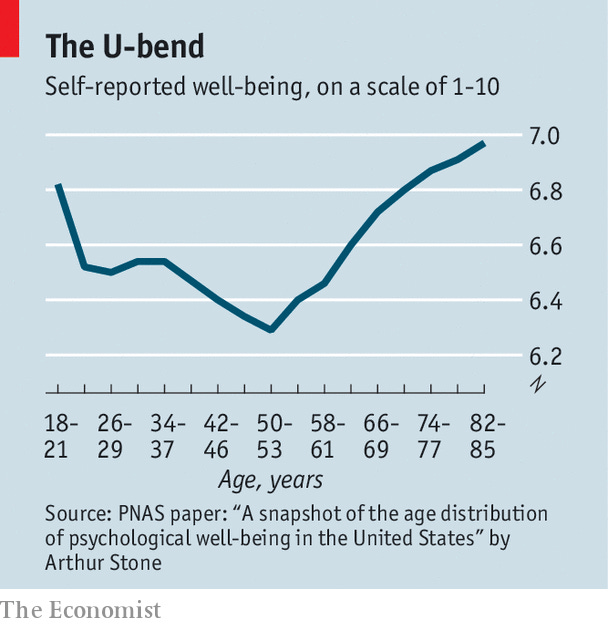
Now look at the timing. The lowest point often coincides with adulthood. The years when we build families. Raise children. Lead teams. Create value. Carry real responsibility.
The most meaningful part of life is also the most miserable. Instead of joy and pride, we report stress and anxiety. Instead of fulfillment, we feel behind. Instead of coherence, we feel fragmented.
How can that be? And what can we do about it?
Sparta
Sparta had a system called the Agoge. The Agoge was a mandatory training and education program designed to shape children into adults, cultivating loyalty to the tribe, pain tolerance, discipline, and endurance.
Other cultures did the same in different forms. In Judaism, the Bar Mitzvah marks the moment a child becomes morally accountable before the community. In Christianity, Confirmation historically meant public vows and full responsibility within the faith. In many Indigenous societies, adolescents were separated from family, fasted, isolated, mentored by elders, and reintroduced with new obligations.
Arnold van Gennep, an anthropologist, noticed that most traditional cultures shared the same three-step structure when children evolved into adults: separation, liminality, reintegration. You leave who you were. You enter a painful in-between. You return transformed.
Today, we blame adulthood misery on social media, capitalism, rising housing costs, the decline of religion and community, modern work structures, or economic pressure.
And yes, all of these shape the environment and play a role. But we keep ignoring the elephant in the room: adulthood requires a new self.
Developmental animals
Adulthood is not just a sociological shift. It’s biological.
Your body and brain are wired for stages. Exploration in youth. Risk-taking in adolescence. Stabilization and protection in adulthood. This is not poetry. It is developmental biology. Hormones shift. Reward systems recalibrate. Priorities reorganize at a neural level.
In your 20s, dopamine strongly rewards novelty, status, expansion. The brain is hypersensitive to possibility. Risk feels energizing. Keeping options open feels intelligent.
But over time, the system rebalances. Novelty loses some of its charge. Attachment circuits strengthen. Long-term consequences weigh more heavily. The prefrontal cortex, responsible for planning and impulse control, becomes more dominant. Protection, continuity, and responsibility begin to feel more coherent than endless exploration.
So when today’s ever-expanding, ever-optimizing culture collides with a biology that is slowly favoring anchoring and integration, friction appears. And anxiety becomes structural.
Compression
Think about it clearly.
Your 20s were very likely about you. No children. No real long-term consequences. No teams depending on you. No aging parents requiring care.
So you optimized for expansion. Growth. Status. Exploration. Optionality. You built the foundations of your future life: a career, a partner, a role in society. Rightly so.
But adulthood flips the ecosystem. Now there is a family. A partner. A team. Children. Aging parents. Long-term financial exposure.
The system demands more from you. If you keep optimizing for expansion inside a system that demands compression, you crash. You cannot keep pouring gasoline into an engine that is already running at full speed.
Adulthood is no longer about doing more. It is about being more.
Operating model
This transition is not just philosophical. It is operational. You cannot think your way into adulthood. You must redesign your life.
In future pieces, we will go deep into these shifts. For now, here are some thought starters:
Finances: From maximizing income and upside and embracing risk, to building stability, resilience, and margin.
Work: From work as identity to work as infrastructure. From chasing growth to creating value through specialization and reliability.
Life partner: From romance as intensity to reliability under stress and deep, shared values when exhausted. To mutual long-term growth.
Friendship: From new, exciting circles to protecting the few who know your history. From variety to continuity.
Time: From filling every gap to defending empty space.
Health: From performance and image to longevity and repeatability.
It is not black and white. You still need romance. You can still take calculated risks. You can still be ambitious. But the center of gravity shifts. Expansion stops being the priority. Stability and depth take the lead.
Maturity
Maturity is recognizing this shift and learning to love it. Loving a slow afternoon with your child more than the stimulation of another meeting. Loving deep conversations with two close friends over networking dinners. Loving routines instead of novelty. Loving predictability over chaos. Loving roots over expansion. Loving depth over stimulation. Loving being needed more than being admired.
Adulthood is overwhelming when we resist it. It becomes meaningful when we embrace it.
The question is not how to avoid the U-curve. The question is whether you are willing to become the version of yourself that this stage of life requires.
And this is not the end of who you were. It’s the beginning of who you’re meant to be.
Thanks for reading 3x!
If this resonated with you, hit the ❤️ and leave a comment—it means a lot. And if you know someone who’d appreciate it, share it via email, WhatsApp, or on social media. Good ideas are better when shared.
Subscribe just below to stay in the loop. 👇
Related articles on addiction, work & stress


Week after week. The one newsletter that always brings coherence to this fast-paced world. Real Kudos!!